
|
|||||||
|
|||||||
|
|
|||||||
|
|||||||
|

Behind a concealing boulder, he knotted a strip of woven material around his midsection as a loincloth, then waded out chest-deep into the water.
The sea was pretty turbid, but in the foot or so of visibility, he could see ctenophores surfacing periodically and then sinking into the waves. After a few minutes, he realized the water must be teeming with them. He scooped at one, attempting to catch it. It slithered over his fingers and jetted away, turning a brilliant orange as it did so. He tried again, and again, but got nothing but tickles of slimy tentacles and plenty of splashing.
After a few minutes of this, his face was flushed, his eyes stung, and his mouth tasted of salt. He turned to wade to shore, but then a single beast swam up right in front of him and hovered at the water’s surface. He rubbed his eyes and bent to look more closely at it. He observed the creature had distinct eyes, with pupils shaped like commas, and this pair of eyes appeared to be looking intently at him. Tentatively, he dipped his hand into the water. This time, the animal swam directly into it. It balanced patiently in his palm as he lifted it out of the water and examined it.
It was the size and shape of a small mango, with ten flexible legs arranged near the two eyes he’d already observed. He assumed that the complicated structures buried amidst the legs were its mouth parts. Its body was segmented in five, and each of the five segments had structures floating in it that resembled circuit boards, but with no corners; all the edges were rounded. Its skin was translucent. As he watched, a large patch on its back flattened out and turned an opaque white. Ge’ez characters floated to the surface of the screen.

Today is the big day. The final installment of the Eupocalypse trilogy is available on Amazon (Kindle and paperback) as well as Nook, Apple Books, Kobo, and as a PDF.
For me as an author, this is a big milestone. This series of thriller/visionary novels has been in progress for three years. Its depiction of the transformation of the world has paralleled the destruction (due to disabling illnesses and adverse professional-practice conditions) and the rebuilding of my own life overseas during the same time period.
In that time, I’ve had a chance to re-sharpen my writing and editing skills and rediscover and reprioritize my life and values. I thank all the readers and authors who’ve helped me along the way and who’ve trusted their work to my editing skills.
Some of you have urged me to keep writing in the Eupocalypse world, but the ctenophores aren’t summoning me back just yet. Who knows what tomorrow may bring? Whatever it is, this trilogy has been a voyage of discovery for me. I humbly extend my hope that it may be the same for you as a reader.
–Peri
I am so excited I can’t contain myself! I just finished the final readthrough of the final draft of the final book in the Eupocalypse trilogy! There’s cover set-up and all the housekeeping chores that have to be done to get the book into your hands…or onto your electronic device!
It’s a bittersweet moment for an author to let the story stand on its own and toddle off into the world. But how else can I share the excitement?

The insightful and quirky blog of sci-fi writer/editor Michelle Brown, SciFi Magpie, made mention of the Eupocalypse series this week. It’s a rare honor for an editor to step out and highlight one of her clients’ work in her own valuable blog real estate, so on that count I am grateful. But on another level, her post is very insightful about the reasons we read (an write) post-apocalyptic fiction

and what gifts we take from it.
Give it a read:
https://scifimagpie.blogspot.com/2018/11/bad-broken-and-seed-of-hope-how-dark.html
There’s a reason the first chapter of Machine Sickness starts in the South. There’s a reason Deirdre Davis is a southerner. That wasn’t by chance, and it wasn’t solely because I chose to follow the classic writer’s advice to “write what you know.” I have lived in the southern USA for more of my life than anywhere else, but I was born in the West, grew up in New York City, went to undergrad school in Chicago, got my Doctor of Chiropractic degree in Atlanta, and now I live in Mexico.
The shame and rage that Americans feel about the hypocrisy of a nation supposedly based on freedom that compromised that principle for political unity, is othered and alienated and transferred to the South. To read mainstream media, you would think that slavery, legally-mandated segregation, racial massacres, and lynching were isolated only in the South and performed only by Southerners, whereas the truth is that these abhorrent practices were common in the North even after slave importation was banned and even after the passage of the 13th Amendment. Reading mainstream media, you’d imagine that the people whom it is still okay to refer to by ethnic pejoratives like “redneck” and “hillbilly” (usually preceded by the word “ignorant”), were the ones responsible for slavery, when the “poor white trash” of the South were overwhelmingly not slave owners and some suffered from a job market depressed by slave labor. While the elite generals of the Union were wined and dined by plantation owners, the 1-percenters of their day, these people were scorned. The plagues of domestic violence, alcoholism, and learned economic helplessness descended through generations.
The historical awareness among Scots-Irish descendants of being on the losing side of the Civil War is exacerbated by the tradition of military honor and clan loyalty passed down from their gaelic-language-speaking ancestors of the British Isles. The sense of unfair play of small holders, sharecroppers, and agricultural workers, whose red necks came from exposing white skin to the Southern sun while growing the raw materials for Northern factories, yielded a coarse and sometimes grim sense of humor, so that DD remembers her mother saying she was “always one to call a spade a goddam shovel.”
In DD, you have a character somewhat like Detective Clarice Starling in the Hannibal Lecter stories. In one prison interview scene, Hannibal gets under Clarice’s skin by pointing out that she is only a couple of generations removed “from poor white trash.” DD is a brilliant scientist, a highly educated woman, but she will never completely shake the hypervigilance and pragmatism of her background; her family relationships reflect a modern alienation as well as epigenetic dysfunction; she doesn’t design or engineer, she tinkers. She’s acutely aware of physical threats to her safety in ways that people who’ve always felt safe are not, but what goes unstated is that she’s also aware of those who are superlatively safe and don’t feel like it.
Yet, the Eupocalypse is an opportunity to start over in a world where notions of class and wealth, risk and safety, are recalibrated. It’s a world where the materials of modern life are lost, but the ideas are not.


Things are getting really weird here in indie author land. Checked the news today and a complete shutdown of the Atlanta Hartsfield Airport was all over the media. Apparently, somebody read this chapter of Machine Sickness and decided put it to the test:
At the Atlanta airport, tempers were frayed.
Long lines of people waited to receive scrawled paper vouchers for meals from harried ticket clerks who were helpless without their computers. Tim, hung over from his prior night’s partying with Sam’s old school friends in “Hot-lanta,” stopped next to one such line and listened to an expensively-coiffed and bejeweled woman in her 30s raise her voice. “What do you mean you can’t accommodate me? Do you know who I am?”
Tim murmured, “She doesn’t know who she is? Why is she wasting everybody’s time?” A geeky blue-haired teenage girl standing in the line heard him. She turned around giggling, and he cut her dead with his trademark disdainful eye-roll.
The monitors showing arrivals and departures had been exhibiting multicolored confetti for quite some time. Suddenly, the power to the displays was abruptly cut; they all went black. The overhead lights went out, but the big windows of the concourse admitted daylight. A flight attendant zipping down the corridor, pulling her rolling travel case, staggered as the plastic handle on the case broke cleanly in half. The case rolled towards Tim, who pretended not to see it and lifted his foot as though pulling up his sock, kicking it and sending it somersaulting. The flight attendant limped after it awkwardly on a broken heel, holding the broken handle. It made Tim feel better for a moment.
Tim spun and glided towards the exit, glad now he’d been checking luggage and so he hadn’t returned his rental car before checking in at the kiosk. If he’d done things in the usual order, he’d be stuck here with all these idiots. He could still retrieve the car from short-term parking and drive to Miami. He’d picked up some Adderal from one of Sam’s buddies last night, so he should have no problem at all making the drive straight through.
Seriously, first the Texas Gulf Coast is hit by disaster (just like in the book), and now this…it makes a girl who writes books about the End of the World as We Know It, a little reluctant to finish book 2, Watch It Burn!

Nefertiri’s Warriors is a short fantasy story which occurs in the future of the second book in the Eupocalypse series, Watch it Burn, to be published in early 2018. Fill out the form below to receive notifications of free books and stories, and to be among the first to know when the next book in the series is published!
[convertkit form=5102779]
Being an author is more than just creating entertainment; in its best form, it’s a way of communicating a world view and a philosophy of life. Sometimes people ask for a succinct definition, such as today: On a social media site, an insightful young lady asked me, “Where do you look for hope, inspiration, or safe haven?”
This is my response:
There is no safe haven; there is only a brief blink of fragmented awareness as we hurtle through endless space. For hope, I look at the remarkable progress that people have made in the past 200 years in solving the problems of oppression, poverty, and warfare while creating unimaginable levels of comfort and convenience, all without help–nay, despite the interference–of those who would command and control them, steal their wealth, and take the credit. I am inspired by people I meet in daily life who manage to create incredible knowledge, insight, beauty, and usefulness despite the challenges common to the human condition.
This is the eupocalypse vision: the world as we know it is ending, has already ended. But the root of the word “eupocalypse” is “eu”, meaning “good,” or “right.” The seed of the network that is humanity is already embedded in the ground of our world.


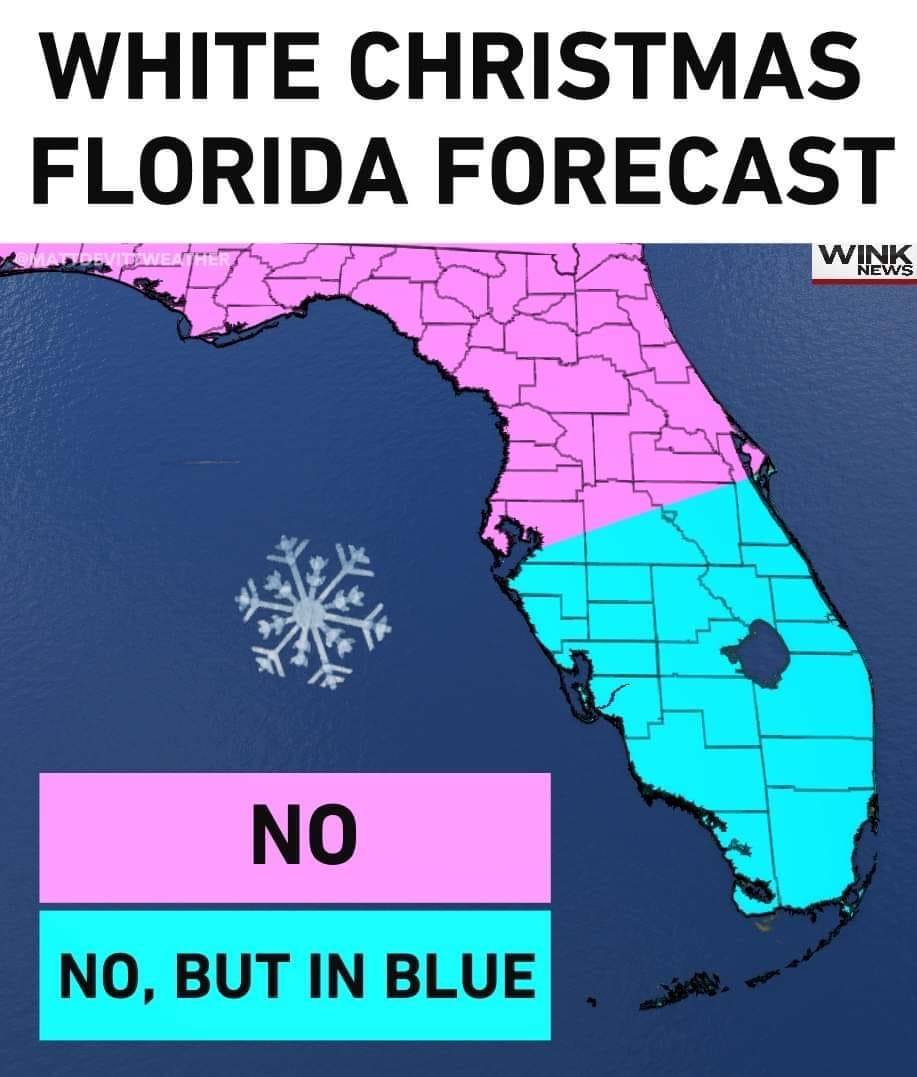
 I’d love to include some photos of him making a gingerbread house, riding the Christmas train at the mall, and opening presents, but his parents have the good sense to be cautious about putting him out on the internet. So instead, I give you our Florida weather forecast from Christmas Eve:
You must be logged in to post a comment.